

Submission guidelines
I. STRUCTURE
I.1. Title page
The title page of the manuscript includes the following components:
∙ The title of the manuscript must be presented in uppercase and bold. If the title extends beyond one line, it should be formatted in V-shaped layout. The title should be concise, clear, accurate, and fully reflect the core content of the research.
∙ Author name(s) should be written in full (without titles or positions) and accompanied by footnotes indicating the authors’ institutional affiliations and ORCID codes (if available).
∙ The corresponding author must provide a contact email address in addition to the institutional affiliation.
An example of the article’s title page is as follows:
MANUSCRIPT TITLE
Nguyen Van A1, Nguyen Van B1*
(Footnote: 1Authors’ institutional affiliations and ORCID codes (if available),1*Corresponding author: abc@...)
|
Received: dd/mm/yyyy Revised: dd/mm/yyyy Accepted: dd/mm/yyyy (*) JEL Classification: Authors should refer to the JEL classification codes using the following link (**) Keywords: List 3–5 keywords in alphabetical order (*) The Editorial Board will complete this information once the manuscript is accepted for publication. (**) JEL code for reference: https://www.aeaweb.org/econlit/jelC odes.php?view=jel |
The abstract should not exceed 200 words and must be presented in a single paragraph, in italics, with a font size of 12 and single line spacing. The abstract should include the following elements: ∙ Significance of study ∙ Research objectives ∙ Research methods ∙ Key findings or novel contributions ∙ Key implications or recommendations |
I.2. Main Content of the manuscript
The manuscript consists of the following sections:
- Introduction/Rationale
This section should clarify the significance of the research, including:
∙ Identification of the research problem
∙ Explanation of its importance
∙ Identification of the research gap that the manuscript aims to address
∙ Presentation of the research objectives and questions
- Literature Review
2.1. Review of previous studies
The literature review should focus on analyzing the research methods, findings, and implications of previous studies or publications directly related to the research topic.
HJEM encourages authors to synthesize and cite peer-reviewed articles from reputable international journals indexed in Scopus and Web of Science (SCI, SCIE, SSCI, etc.), as well as other academic journals listed in the official annual list issued by the State Council for Professorship of Vietnam.
2.2. Theoretical Framework / Research Model
This section presents the theoretical and practical foundations of the study, including relevant theories, concepts, and key variables or factors. These elements serve as the basis for proposing the research model and hypotheses.
- Research Methods
The research methods section should clearly describe:
∙ Study design.
∙ Data collection methods: Describe both secondary and primary data sources. For primary data, specify the target population, sample size, sampling technique, and data collection procedures.
∙ Data analysis methods: Present the analytical methods and models used to analyze the research data.
- Results and Discussion
4.1. Results
This section presents the research findings, including qualitative and/or quantitative analysis results. These results may be illustrated using tables, diagrams, charts, and graphs. When presenting results, authors must accurately refer to the corresponding table, figure, or chart numbers in the manuscript.
4.2. Discussion
Authors should analyze and interpret the meaning and implications of the research findings; compare the findings with previous studies; and highlight the novel contributions of the study.
- Conclusion and Recommendations
This section summarizes the main research findings, the novel contributions of the study, and policy implications. Authors may also include research limitations and suggestions for future research.
Declaration
- Acknowledgement: The author(s) acknowledge the financial support and assistance of relevant parties, including funding sources and information-providing partners (if any).
- AI usage:
- In case AI tools are used: The author(s) must confirm the use of artificial intelligence (AI) tools to assist with language editing, grammar checking, and improving the clarity of the manuscript (to be specified according to actual use). These tools were not used to generate core academic content, conduct data analysis, or draw research conclusions. All scientific content, results, and interpretations presented in the paper are the sole responsibility of the author(s).
- In case AI tools are not used: The author(s) confirm that no artificial intelligence (AI) tools were used to generate core academic content, conduct data analysis, or draw research conclusions. All scientific content, results, and interpretations presented in the paper are the sole responsibility of the author(s).
- Data availability: The corresponding author is responsible for archiving the research data and must be ready to provide evidence or datasets supporting the research findings presented in the paper upon request.
- Ethics and conflict of interest: The author(s) confirm that the research process complies with relevant research ethics regulations (if applicable) and that there are no conflicts of interest among the involved parties that could influence the research results presented in the paper.
References
Authors must accurately, completely, and honestly cite all sources used in the manuscript, including data, images, maps, and the findings of other researchers. The reference list should include only sources that are cited in the manuscript.
II. FORMATTING GUIDELINES
2.1. Length and Formatting
The manuscript submitted to HJEM must not exceed 6,000 words, excluding references and appendices.
- Font: Times New Roman
- Font size: 12
- Paper size: A4
- Margins: 1 inch on all sides
- Spacing: Before: 6 pt; After: 0 pt; line spacing: single
2.2. Tables, Figures, and Equations
Tables should be formatted as follows:
- The table number (in bold) and table title should be placed above the table and center-aligned.
- Source placed below the table on the right, in italics.
- Notes (if any) placed below the table on the left, font size 10.
Example of results derived from primary survey data (Results from primary data collected and analyzed by the authors do not require source citation): 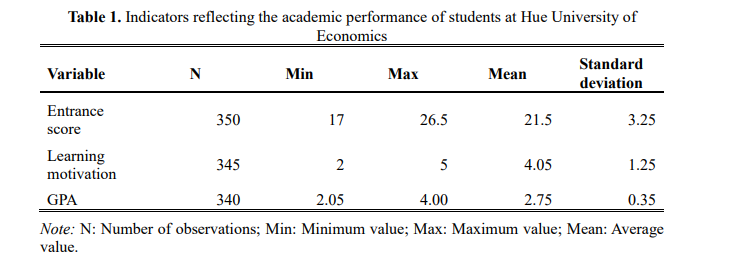
Example of results derived from secondary data: 
Figures and charts should use Times New Roman font; avoid colored backgrounds and 3D chart styles. The title of the figure/chart should be placed below the figure. Example: Equations appearing in the manuscript should be created using the Equation function in Microsoft Word, italicized, center aligned, sequentially numbered. Example:
  2.3. Citation and Reference formatting
Citations and references must follow APA Style (7th edition).
In-text Citation
- For works with 1–3 authors, cite all authors’ surnames.
Example: Nguyen, Tran, and Hoang (2026)
- For works with 4 or more authors, cite only the first author’s surname followed by “et al.” Example: Nguyen et al. (2026)
- For secondary data presented in tables, charts, graphs, or diagrams, the data source must be clearly cited below the table/figure. No source citation is required for primary data collected and analyzed by the authors.
Reference list formatting
Reference list formatting: Before: 6 pt; After: 0 pt; Line spacing: single; Left indent: 0.5 inch - Journal articles
Journal title and volume number in italics; Issue number in parentheses (not italicized); Do not include “Vol.” or “No.”; If DOI is available, provide the full https link; If there is no DOI and printed version access, provide URL.
Example:
Nguyen, V. A., & Tran, T. B. (2025). Digital transformation in small and medium enterprises in Vietnam. Journal of Management and Economics, 18(3), 45–56. https://doi.org/xxxxx.
- Books
Author’s full name (Year). Book title. Publisher.
Example:
Truong, T. Q. (2025). Advanced Econometrics. Hue University Publishing House. - Translated books
Author’s full name (Year). Book title (Translator). Publisher (Original work published xxxx) - E-books
Author’s full name (Year). Book title. Publisher. DOI or URL.
- Organizational reports
With DOI: Organization Name. (Year). Report title. https://doi.org/xxxxx. Example:
World Bank. (2025). World Development Report 2025: Economic Development and Societies. https://doi.org/xxxxx.
Without DOI: Organization Name. (Year). Report title. URL.
- Master’s Theses or Doctoral Dissertations
Unpublished thesis/dissertation
Author’s full name (Year). Title [Master’s thesis/Doctoral dissertation, Degree-granting institution].
Example:
Nguyen, V. A. (2024). Digital transformation solutions for SMEs in Vietnam [Doctoral dissertation, University of Economics, Hue University].
Thesis/dissertation available in a database
Author’s full name (Year). Title [Doctoral dissertation/Master’s thesis, Degree-granting institution]. Database name.
Example:
Tran, L. M. (2021). Marine economic development in the South Central region [Doctoral dissertation, University of Economics, Hue University]. ProQuest Dissertations & Theses Global.